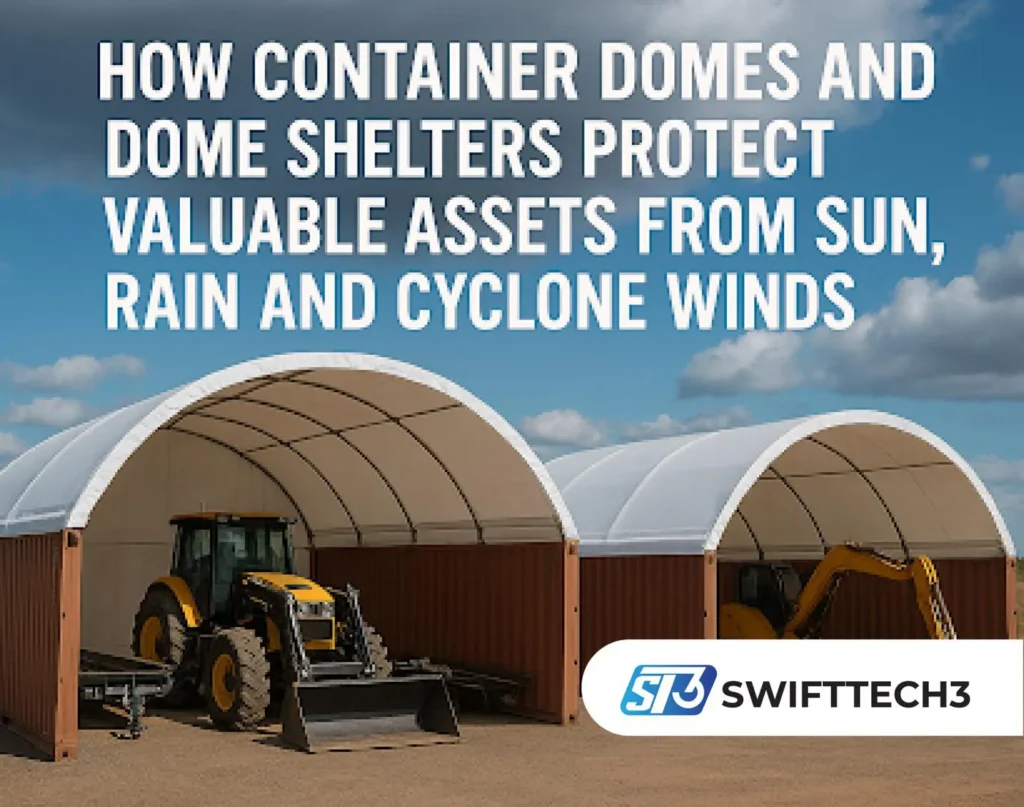
A dome shelter’s wind rating isn’t a marketing claim — it traces back to a specific structural engineering standard, and increasingly, what’s stored underneath it is monitored by wireless sensors rather than a periodic walk-through. Both of those facts matter more than the shape of the roof when you’re deciding whether one of these structures actually protects a valuable asset.
The Standard Behind “Cyclone-Rated”
In Australia, any claim about a structure withstanding cyclone winds should trace back to AS/NZS 1170.2, the joint Australian/New Zealand standard for structural wind actions. The country is divided into wind regions — A through D, with D covering the most cyclone-exposed coastal areas — and a structure’s design has to account for the specific regional wind speed, terrain category, and (as of the 2021 revision) a climate change multiplier that accounts for increasing storm intensity.
That’s a meaningful detail buyers should ask about directly: a shelter “rated for cyclone winds” should have an engineer’s assessment tied to a specific wind region and terrain category, not a general claim. Container domes and similar structures typically publish which wind region and importance level they’re engineered for — worth confirming against your actual site location before assuming a rating applies.
Why the Curved Shape Actually Works
The aerodynamic argument for a dome shape over a flat roof is real, not just a design preference. Curved surfaces distribute wind pressure more evenly and reduce the drag that flat walls experience when hit directly. Combined with a galvanised steel frame and proper anchoring — bolted to shipping containers, fixed to ground plates, or secured with earth screws or concrete footings — the structure resists uplift and lateral movement rather than taking the full force of a gust head-on. The tensioned fabric cover adds a second layer of resilience: it flexes under load instead of cracking the way rigid roofing can.
What’s Actually Being Monitored Inside Now
The bigger shift in how these shelters are used isn’t the shelter itself — it’s what’s tracking conditions underneath it. Wireless environmental sensors, typically using LoRaWAN or similar low-power wide-area networks, are increasingly deployed in agricultural and industrial storage settings to continuously track temperature and humidity rather than relying on someone physically checking. That matters directly for the kind of assets dome shelters are built to protect — feed, timber, machinery components, and packaging materials that degrade quickly once humidity or heat exceeds a threshold.
How the Monitoring Actually Works
| Monitoring approach | What it does | Where it fits |
|---|---|---|
| Manual spot-checks | Staff periodically inspect stored goods | Low-cost, but gaps between checks can miss a fast temperature or moisture spike |
| Wireless temperature/humidity sensors | Continuous readings sent to a phone or dashboard, with threshold alerts | Remote agricultural or mining sites where staff visits are infrequent |
| Full IoT platform integration | Sensor data feeds into a broader asset or fleet management system | Larger operations tracking multiple sites or storage structures at once |
A basic wireless sensor setup can alert a site manager the moment humidity crosses a set threshold inside a shelter — the same principle already driving broader adoption of wireless monitoring devices across small and mid-sized businesses generally, just applied specifically to remote storage conditions.
The Harder Part: Getting Hardware and Software to Actually Work Together
Deploying sensors inside a dome shelter sounds simple until you account for connectivity. Remote farms, mining sites, and construction yards often don’t have reliable Wi-Fi, which is exactly why low-power, long-range protocols were built in the first place — they’re designed to transmit small amounts of data over kilometers on minimal battery power, rather than assuming constant high-bandwidth connectivity. Getting sensor hardware, a gateway, and a monitoring dashboard to work together reliably in these conditions is its own integration challenge, similar to the broader pattern covered in why hardware-software integration matters for IoT products — the sensor itself is rarely the hard part; making the whole system talk to each other reliably in the field is.
Personal Experience: What Actually Failed First
I’ve seen a small agricultural operation install a straightforward wireless humidity sensor inside a dome-covered storage area after a season of unexpected mould damage to stored feed. The sensor itself worked fine. What actually failed first was the gateway placement — it was positioned too far from the shelter to get a reliable signal, so alerts arrived hours late on bad connectivity days, which defeated much of the purpose.
The fix wasn’t more expensive hardware, it was moving the gateway closer and testing signal strength before finalizing the install. That’s a cheap lesson to learn on paper and an expensive one to learn after a batch of feed spoils — worth testing before committing to a full sensor rollout.
Questions Worth Asking Before Installing Either
- What wind region and importance level is this specific structure engineered for, and does it match your actual site?
- Does the anchoring method match ground conditions at your location, or was it specified generically?
- If adding sensors, what’s the realistic gateway range at your site, and has anyone actually tested signal strength there?
- Does sensor data need to integrate with an existing asset management system, or will it run as a standalone alert tool?
FAQ
What does “cyclone-rated” actually mean for a dome shelter?
It should mean the structure was engineered against AS/NZS 1170.2 for a specific wind region and importance level — always worth confirming which region applies to your site.
Do dome shelters need footings or can they be relocated easily?
Both options exist — bolted, ground-plate, or concrete footing anchoring for permanent sites, versus more portable anchoring for shelters that need to move between temporary worksites.
Can wireless sensors be added to an existing dome shelter?
Yes — most humidity and temperature sensor systems are retrofit-friendly, though gateway placement and signal range need testing at the specific site.
Do these sensors require Wi-Fi?
No — many use LoRaWAN or similar low-power wide-area protocols specifically because they don’t depend on traditional Wi-Fi coverage in remote locations.
Is a dome shelter better than a flat-roof shed for wind resistance?
Generally yes for wind deflection specifically, since curved surfaces distribute pressure more evenly than flat walls, though actual performance still depends on anchoring and construction quality.
Actionable takeaway: Before trusting any wind rating or a sensor-based monitoring claim, ask for the specifics — the wind region and importance level for the structure, and a tested signal range for any sensor gateway. Generic assurances on either front are the most common gap between what’s promised and what actually holds up on-site.