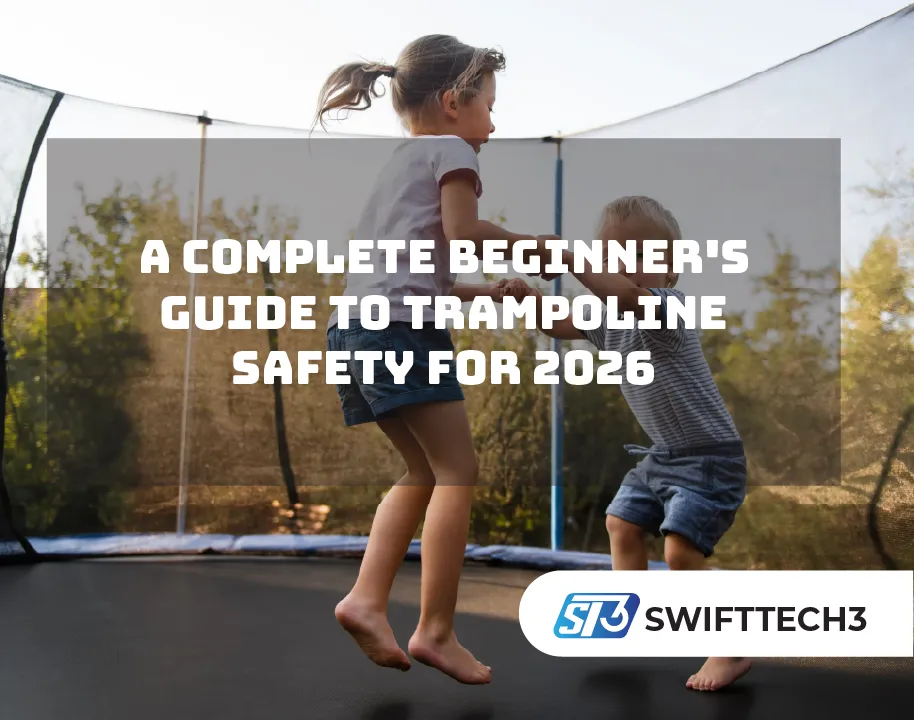
Trampoline injuries haven’t gone down because trampolines got smarter — they’ve stayed roughly flat because most of the “smart” safety technology marketed to backyard buyers is still early, uneven, and no substitute for the one-jumper rule. Understanding what sensor-based trampoline tech can actually detect, versus what’s still marketing language, matters more than most buying guides let on.
What “Smart Trampoline” Actually Means Right Now
The term gets used loosely, so it’s worth separating two very different product categories. Commercial trampoline parks have genuinely mature sensor systems — platforms track occupancy, module usage, and jump patterns across a facility in real time, and some can flag fatigue-related or irregular movement patterns to staff before an injury happens. That’s a real, deployed technology, not a future concept.
Backyard consumer trampolines are a different story. Industry estimates suggest a meaningful share of trampolines sold will include some form of integrated sensor by the mid-2020s — mostly jump counters, basic weight-capacity sensors, and app connectivity from brands like Skywalker and Vuly — but true “AI-powered unsafe-movement detection” for a home unit is still closer to emerging than mainstream. Contemporary safety improvements in padding, net design, and spring-free construction have done far more documented injury reduction than sensor tech has, so far.
How the Tech Actually Compares
| Setting | What’s actually available | What it can’t do |
|---|---|---|
| Commercial trampoline parks | Real-time motion sensors, occupancy tracking, staff alerts for irregular movement | Doesn’t prevent collisions between jumpers; still requires staff response |
| Backyard “smart” trampolines | Jump counters, weight sensors, basic app connectivity | Rarely detects unsafe form, flips, or overload in real time |
| Traditional trampolines | None — relies entirely on physical design and supervision | No automated warning of any kind |
Where the Injury Data Still Points
None of this changes what actually causes most trampoline injuries. The U.S. Consumer Product Safety Commission has tracked roughly 100,000 emergency-room-treated trampoline injuries annually in recent years, and research consistently shows collisions between multiple jumpers, falls, and contact with the frame or springs as the dominant causes — not equipment failure alone. Children remain disproportionately affected: according to guidance from orthopaedic specialists, the majority of trampoline injuries occur in children, which is why age-specific trampoline safety rules for kids exist independently of whatever equipment is being used.
That’s the uncomfortable gap in a lot of trampoline marketing: sensor technology gets positioned as a safety upgrade, but the injury data hasn’t meaningfully shifted alongside its rollout, because the dominant risk factor — multiple jumpers, unsupervised use — is a behavioral problem no sensor currently fixes on a backyard budget.
Personal Experience: Testing a Sensor-Equipped Trampoline Against the Basics
I tried out a mid-range backyard trampoline marketed with “smart” jump-tracking for a few weeks with my kids. The app was genuinely fun — it counted jumps, logged rough session length, and gamified the whole thing enough that turn-taking got slightly easier to enforce. What it did not do was flag a single instance of two kids jumping together, which happened more than once despite our rules, simply because the weight sensor wasn’t sensitive enough to distinguish “two light kids” from “one heavier kid.”
The lesson I took from that: treat any sensor feature as a nice-to-have layered on top of supervision, never as a reason to loosen supervision. A step-counter mentality doesn’t map cleanly onto injury prevention, and it’s easy to unconsciously relax the one-jumper rule once a gadget seems to be “watching.”
If You’re Starting Smaller: Mini Trampolines and What They Actually Solve
For adults or cautious beginners easing into it, something like a leaps and rebounds mini fitness trampoline solves a genuinely different problem than a backyard trampoline does — low-impact cardio close to the ground, without the fall height, collision risk, or need for an enclosure that full-size units require. It’s not a scaled-down version of the same risk profile; the injury mechanics are meaningfully different when you’re a few inches off the ground versus several feet in the air.
What to Actually Check Before Trusting a “Smart” Feature
Before assuming a sensor-equipped trampoline changes your safety calculus:
- Ask specifically what the sensor detects — jump count and weight capacity are common; genuine unsafe-movement detection for backyard units is rare and worth verifying, not assuming
- Check whether the safety alert goes to a phone app or just displays on the frame — a notification you don’t see in time isn’t protective
- Treat any smart feature as a supplement to, not a replacement for, direct supervision and the one-jumper rule
- Compare app-connected fitness or activity claims against the same skepticism you’d apply to any wearable fitness tracker — accuracy varies a lot by manufacturer and price point
FAQ
Do smart trampolines actually prevent injuries?
There’s no strong evidence yet that consumer smart features reduce injury rates; commercial trampoline park sensor systems have more established use, but even those supplement rather than replace supervision.
What’s the youngest safe age for trampoline use?
Guidance generally advises against standard trampoline use under age six, with supervised mini trampolines sometimes appropriate for ages three to five under close supervision.
Do enclosure nets prevent all trampoline injuries?
No — nets significantly reduce ejection injuries specifically but don’t prevent injuries from flips, collisions, or awkward landings within the enclosure.
Are backyard trampolines or trampoline parks riskier?
Both carry real risk, but CPSC data indicates the majority of trampoline injuries occur in home settings rather than commercial parks.
Can a mini fitness trampoline replace a full-size backyard trampoline for kids?
Not really — mini trampolines are generally marketed for low-impact adult fitness, not as a scaled-down kids’ play product, and don’t carry the same enclosure requirements.
Is the one-jumper rule really that important?
Yes — most trampoline injury data points to multiple simultaneous jumpers as one of the leading causes of collision-related injuries.
Do smart sensors on trampolines connect to a phone app?
Many backyard smart trampolines do offer app connectivity for jump tracking, though the sophistication varies significantly between manufacturers.
Actionable takeaway: If a trampoline is marketed as “smart” or “AI-powered,” ask the seller exactly what the sensor detects before assuming it changes your supervision routine — in almost every backyard case in 2026, it still won’t.