Introduction
Ask any finance manager in India what keeps them up before the 20th of every month, and “GST filing” will come up within the first two sentences. Between chasing missing invoices, matching purchase records against GSTR-2B, and hoping a single typo doesn’t trigger a mismatch notice, GST compliance has quietly become one of the most time-consuming parts of running a business here. That’s exactly the gap AI for GST is stepping into.
What’s changed in the last year isn’t just that software vendors are slapping “AI-powered” on their invoicing tools — it’s that the tax department itself has gone all-in on machine learning. The Goods and Services Tax Network (GSTN) now processes billions of API calls a month and runs its own AI-based risk engines to flag suspicious filings in near real time. That means businesses aren’t just choosing to adopt AI for convenience anymore — they’re increasingly filing in a system where the other side of the table is already using it. Understanding both sides of that equation is what separates businesses that stay audit-ready from the ones that get a notice they didn’t see coming.
This article walks through how AI for GST is reshaping invoice management and filing accuracy, what’s genuinely new about the 2026 compliance landscape, and where businesses commonly go wrong when they start relying on automation.
1. Intelligent Invoice Data Capture
Manually keying in hundreds of invoices a month is where most GST errors are born — a transposed GSTIN digit, a missed decimal, an invoice that never made it into the books at all. AI-powered capture tools remove that bottleneck almost entirely.
How It Works in Practice
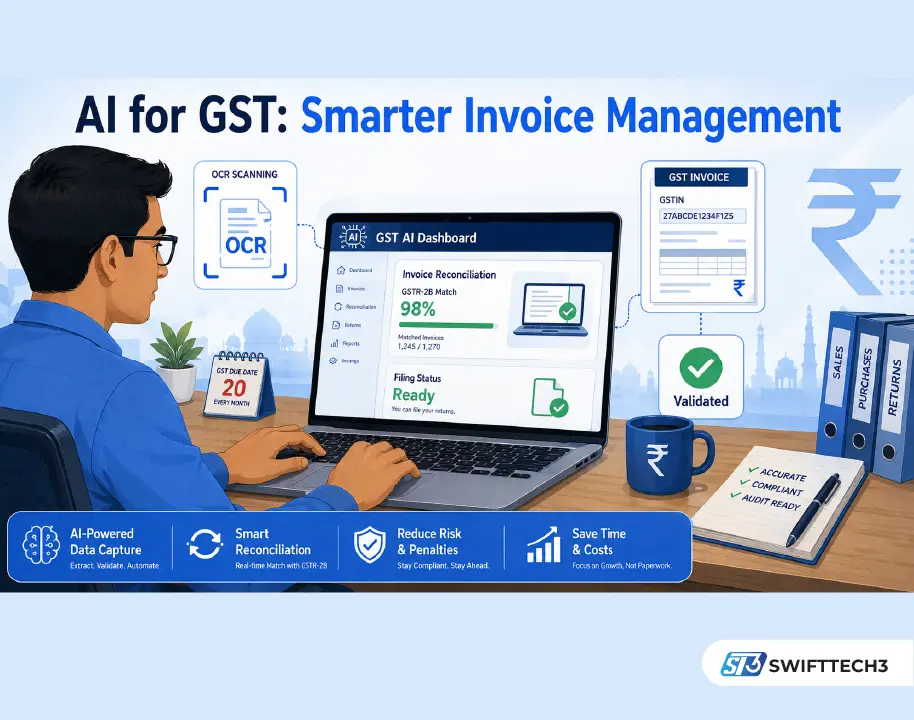
- OCR Integration — Optical Character Recognition reads invoices, bills, and receipts and converts them into structured, filing-ready data, cutting down on manual entry and the errors that come with it.
- Automatic Validation — The system cross-checks captured data against GST formatting rules (like valid GSTIN structure and HSN/SAC codes) and flags anything that looks off before it becomes a filing problem.
- Multi-Format Support — Whether an invoice arrives as a PDF, a scanned image, or a native digital file, the AI layer normalizes it into one consistent dataset.
- Time Savings — Finance teams that used to spend entire afternoons on data entry now spend that time reviewing exceptions the system has already flagged — a shift that mirrors how AI agents are reshaping other back-office systems like ERP platforms.
2. Streamlined Purchase and Sales Reconciliation
Reconciliation is where most GST headaches actually surface — not at the point of invoicing, but weeks later when purchase records don’t line up with what suppliers have filed.
- Automated Matching — AI continuously compares your purchase register against GSTR-2B and sales data, catching mismatches long before the filing deadline.
- Real-Time Alerts — Instead of discovering a discrepancy during month-end close, teams get notified the moment a mismatch appears.
- Continuous, Not Periodic — Reconciliation runs in the background daily, not as a single stressful sprint before the due date.
- Lower Penalty Risk — Catching mismatches early is directly tied to protecting Input Tax Credit (ITC) claims, which is where most compliance disputes originate.
This is also where the difference between basic bookkeeping software and true reconciliation intelligence becomes obvious — the same way year-end financial reporting depends on clean, continuously reconciled data rather than a last-minute scramble.
3. Smart Tax Code Assignment
Misclassifying a product or service under the wrong HSN/SAC code is a quiet but common source of GST errors, especially for businesses dealing in mixed categories.
- Predictive Coding — AI models trained on historical transaction data suggest the correct GST code for each line item, often with a confidence score attached.
- Adaptive Learning — Every manual correction feeds back into the model, so accuracy improves the longer the system is in use.
- Cross-Category Precision — Complex product lines that span multiple tax slabs are handled with far more consistency than manual review typically allows.
4. Real-Time Filing Preparation
Return preparation used to mean pulling data from five different places and hoping nothing was missed. AI collapses that into a continuous, always-current process.
- Auto-Filled Returns — Reconciled invoice and transaction data feeds directly into pre-filled GSTR forms.
- Instant Error Highlighting — Discrepancies in tax calculations or missing invoices are surfaced before submission, not after a notice arrives.
- Accounting Software Sync — Data stays consistent across your books and your filings, eliminating the double entry that used to cause mismatches in the first place.
5. Predictive Compliance Analytics
This is where AI moves from “automating paperwork” to “protecting the business proactively.”
- Trend Analysis — Patterns across invoices and filings help predict where compliance risk is building up before it becomes a problem.
- Risk Scoring — Transactions are scored for the likelihood of discrepancy or audit exposure, so review time goes to what actually matters.
- ITC Optimization — AI can surface unclaimed or underutilized input tax credit opportunities that manual review often misses.
6. The Part Most Articles Skip: GSTN’s Own AI Is Already Watching
Here’s the piece of the story that rarely gets covered when people talk about AI for GST — and it’s arguably the most important development of the last two years.
The tax department isn’t waiting for businesses to adopt AI. GSTN and the Directorate General of GST Intelligence (DGGI) already run their own machine learning systems — BIFA (Business Intelligence and Fraud Analytics) and ADVAIT — that build a silent risk profile for every registered taxpayer based on filing history, ITC mismatch patterns, turnover trends, and sector-level benchmarks. These systems reconcile GSTR-1, GSTR-3B, and GSTR-2B in real time and cross-reference GST data against Income Tax returns and customs import records through ICEGATE to spot inconsistencies a human reviewer would likely miss.
Why This Matters for Your Business
When authorities flag a high-risk pattern — say, a sudden spike in turnover, invoices from a supplier with a poor filing history, or ITC claims that don’t match the paper trail — that risk score can trigger scrutiny under Form GST ASMT-10, or in serious cases, a direct inspection. One documented case from 2026 involved a manufacturer that used two shell companies to generate roughly ₹305 crore in fake turnover and ₹40–50 crore in fraudulent ITC — the anomaly was caught almost immediately by automated turnover-spike detection, not by a manual audit.
The practical takeaway: AI for GST isn’t just about making your own filing faster. It’s about making sure your invoice trail and vendor relationships hold up against a system that is actively scoring you in the background. Businesses that use AI-powered reconciliation on their own side are, in effect, running the same checks GSTN’s engines will run — before the department does. Reviewing your own vendor networks the way a fraud-detection model would (irregular filing patterns, circular trading structures, mismatched e-way bill data) is quickly becoming standard due diligence, not an optional extra.
7. Seamless Integration with Accounting Software
AI for GST works best as a layer on top of your existing accounting stack, not a replacement for it. Integrations with Tally, QuickBooks, and Zoho Books are now standard.
- Two-Way Sync — Data flows automatically between your accounting software and your AI reconciliation layer.
- Unified Dashboard — Invoices, filings, and reconciliation status are visible from one place instead of three.
- Reduced Redundancy — No more entering the same invoice twice across two systems.
- Scales With Growth — Higher invoice volume doesn’t mean proportionally higher manual effort.
8. Enhanced Security and Compliance
GST data is financially sensitive, and AI platforms handling it need to treat security as a core feature, not an afterthought.
- Encrypted Storage — Invoices and tax records are protected against unauthorized access.
- Role-Based Access Control — Team members only see what’s relevant to their role.
- Audit Trails — Every change is logged, which matters enormously if a filing is ever questioned.
- Regulatory Alignment — Platforms are built to track evolving GST rules rather than freeze around a single compliance snapshot.
This mirrors a broader shift happening across compliance-heavy software categories — e-invoicing tools built for regulated sectors are increasingly designed around the same principle: automation only earns trust when the audit trail is airtight.
9. Scalable Solutions for Small and Large Businesses
Whether you’re a two-person startup or a multi-location enterprise, AI-driven GST tools are built to flex.
- Customizable Workflows — Rules can be tailored to how your business actually invoices.
- High-Volume Processing — Thousands of daily transactions are handled without a proportional increase in errors.
- Cost Efficiency — Smaller finance teams can manage compliance loads that would otherwise require additional headcount.
- Fast Onboarding — Most platforms are designed for minimal disruption during setup.
Personal Experience: What I Learned Watching a Mid-Sized Distributor Switch to AI-Based GST Reconciliation
I spent time working closely with a mid-sized FMCG distribution business in its second year of using an AI-driven GST reconciliation tool, and a few things stood out that don’t usually make it into product brochures.
The first was how much time was previously lost to reconciliation that felt “almost right.” Before automation, their finance team would manually match purchase invoices against GSTR-2B once a month, and roughly 6–8% of entries needed rework — not because of fraud, but because of simple things like a supplier filing a return two days late or a rounding difference in tax value. Once daily automated reconciliation was switched on, those small mismatches surfaced within 24 hours instead of piling up until month-end, which meant the team was chasing suppliers for corrections while the invoice was still fresh in everyone’s memory — not four weeks later.
The second lesson was more humbling: automation didn’t eliminate the need for a human reviewer, it changed what the human reviewer actually did. In the first month, the AI tool flagged a batch of invoices from a new vendor as high-risk purely on filing pattern grounds — the vendor had a habit of filing GSTR-1 close to the deadline every cycle. It turned out to be a legitimate, if disorganized, small supplier — not fraud. But it was a useful reminder that risk scores are a starting point for judgment, not a verdict. The team built a simple internal rule: any AI-flagged vendor mismatch above a certain threshold gets a quick manual call before any invoice gets rejected outright.
The biggest mistake I saw other businesses make, based on conversations with peers in the same industry, was treating AI GST tools as “set and forget.” One company implemented automated tax code assignment and stopped reviewing suggestions for nearly six months. By the time someone checked, a handful of newly introduced SKUs had been misclassified because the model hadn’t seen that product category before. The fix was simple — a quarterly review of AI-suggested codes against actual product catalog changes — but it only happened after an avoidable correction notice.
The clearest lesson from all of this: AI for GST earns its value when it’s paired with a light, consistent human review layer. Full automation without oversight is where new risks quietly creep in.
Benefits, Common Mistakes, and Best Practices
Key Benefits
- Significantly fewer manual data-entry errors
- Faster identification of ITC mismatches
- Reduced risk of late filing penalties
- Better visibility into compliance risk before it becomes a notice
- Lower administrative overhead as transaction volume grows
Common Mistakes to Avoid
- Treating AI output as final without a human sanity check on flagged anomalies
- Ignoring vendor-side risk — your ITC claims are only as safe as your suppliers’ filing discipline
- Skipping periodic model review for tax code assignment, especially after adding new product or service lines
- Choosing a tool based on marketing claims alone rather than checking real integration depth with your existing accounting software
- Assuming automation removes the need for a GST practitioner on complex or disputed filings
Best Practices
- Reconcile continuously, not just before the filing deadline
- Set risk-score thresholds that trigger manual review rather than automatic rejection
- Audit AI-suggested tax codes quarterly against actual product/service changes
- Keep a documented audit trail for every AI-flagged correction, in case of future scrutiny
- Treat vendor filing behavior as part of your own risk management, not just theirs
Frequently Asked Questions
Is AI for GST filing legal and accepted by the Indian tax department?
Yes. AI tools assist with data capture, reconciliation, and return preparation, but the actual filing still happens through GSTN’s official portal or authorized GST Suvidha Providers (GSPs). The AI layer prepares and validates data; it doesn’t replace the statutory filing process.
Can AI completely replace a GST practitioner or CA?
No. AI is highly effective at catching data-level errors and mismatches, but interpreting notices, handling disputes, or navigating genuinely ambiguous tax positions still benefits from professional judgment. Most businesses use AI to reduce the practitioner’s workload, not eliminate the role entirely.
How does AI reduce GST filing errors specifically?
By automating data capture through OCR, continuously reconciling purchase and sales records against GSTR-2B, and validating tax codes against historical patterns — all of which reduces the manual entry and cross-referencing that typically introduces human error.
What is BIFA and why should businesses care about it?
BIFA (Business Intelligence and Fraud Analytics) is a government-run analytics system used by the DGGI to detect fake invoicing, ITC fraud, and circular trading patterns across GST filings. It matters to businesses because your own filing and vendor relationships are being scored against similar risk models, whether or not you use AI tools yourself.
Does using AI for GST guarantee I won’t get an audit notice?
No tool can guarantee that. What AI does is reduce the likelihood of genuine errors triggering a notice, and it can also surface risk patterns (like a supplier’s inconsistent filing history) that would otherwise go unnoticed until it’s too late.
Which accounting platforms integrate with AI-based GST tools?
Most established AI GST platforms integrate with Tally, QuickBooks, and Zoho Books, along with other cloud accounting systems, allowing data to sync automatically instead of requiring manual uploads.
Is AI for GST affordable for small businesses, or only large enterprises?
Pricing has become far more accessible over the past two years. Many platforms now offer tiered plans based on invoice volume, making automated reconciliation and filing prep viable for small businesses, not just large enterprises with dedicated finance teams.
What’s the biggest risk of relying too heavily on AI for GST compliance?
Treating AI output as automatically correct without periodic human review — particularly for tax code assignment on new product lines and for vendor risk flags that need context before action is taken.
How is AI in GST different in 2026 compared to a few years ago?
The biggest shift is that the tax department’s own AI infrastructure (BIFA, ADVAIT) has matured significantly, moving from experimental use to active, real-time risk scoring across nearly all registered taxpayers. Business-side AI tools have had to evolve accordingly, focusing more on proactive risk visibility rather than just faster data entry.
Conclusion
GST compliance in India isn’t getting simpler on its own — regulations keep evolving, filing volumes keep growing, and the margin for manual error keeps shrinking. What’s changed is that businesses no longer have to absorb that complexity manually. AI for GST now handles the heavy lifting across invoice capture, reconciliation, tax code assignment, and return preparation, while also giving finance teams the kind of predictive visibility that used to be reserved for large enterprises with dedicated compliance departments.
Just as importantly, understanding that the government’s own AI systems — BIFA and ADVAIT — are actively scoring every registered taxpayer changes how businesses should think about compliance. It’s no longer just about filing on time; it’s about maintaining a clean, consistent, well-reconciled data trail that holds up against automated scrutiny.
Actionable takeaways:
- Move reconciliation from a monthly task to a continuous, automated process
- Treat AI-flagged anomalies as a starting point for review, not a final verdict
- Review AI-suggested tax codes quarterly, especially after adding new products or services
- Factor vendor filing discipline into your own risk management, since ITC claims depend on it
- Choose AI GST tools that integrate cleanly with your existing accounting software rather than operating in isolation
An AI Accountant platform brings these pieces together in practice — offering intelligent GST automation that integrates with existing accounting systems, reconciles data continuously, and surfaces predictive insights to help businesses stay audit-ready. By combining automation with real analytical visibility, it helps finance teams maintain consistent filing accuracy and manage GST obligations with confidence as the business grows.