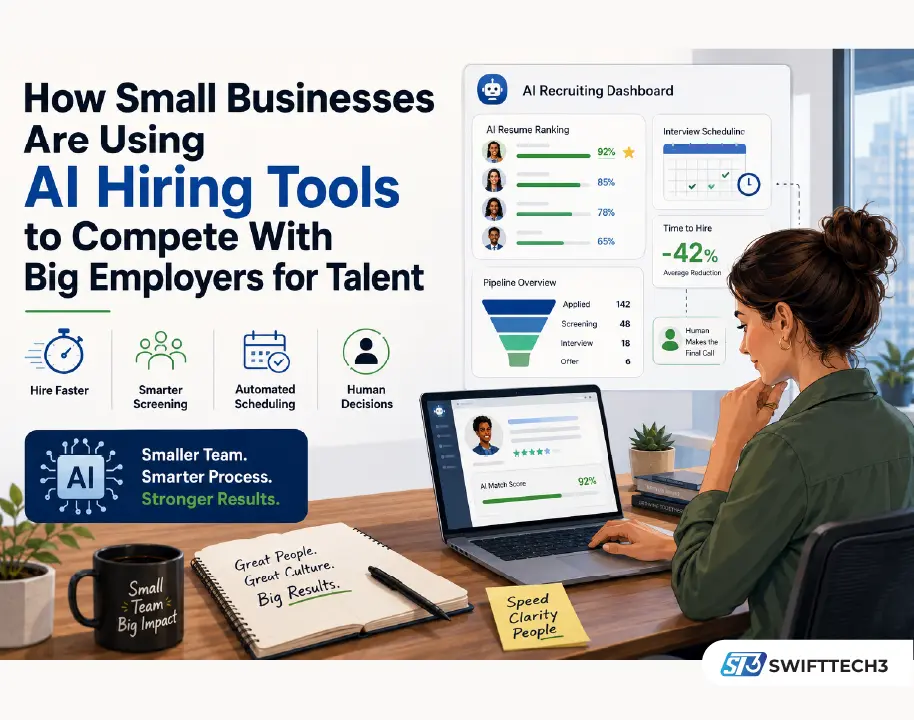
A small business can’t out-bid a company five times its size on salary, and pretending otherwise wastes energy. What it can do is close the process gap — and in 2026, that gap is closing faster because the software got cheap. AI-assisted screening, scheduling, and sourcing tools that used to be enterprise-only are now built into applicant tracking systems that cost less than a single month of a mediocre hire.
Speed Was Always the Advantage. Now It’s a Tooling Problem
A large employer might take three to five weeks to move a candidate from application to offer, once you account for multiple interview rounds, committee sign-off, and background checks. That’s not a policy failure on their part — it’s what happens at scale. A small business without any of that overhead can, in theory, offer in days. The catch is that “in theory” only holds if someone is actually screening resumes and booking interviews fast, and for a five-person team doing that manually between other jobs, the theoretical advantage evaporates by week two.
This is where the tooling shift matters. According to SHRM’s 2025 Talent Trends data, nearly 9 in 10 HR professionals using AI in recruiting say it saves them meaningful time, concentrated almost entirely in screening and scheduling — the two stages small teams struggle with most because nobody has a dedicated recruiter. The starting point for how to find employees for your small business today isn’t a bigger budget — it’s picking software that removes the bottleneck between “we liked this resume” and “we called them.”
Personal Experience: What This Actually Looks Like Week to Week
I’ve watched a nine-person agency go from a six-week average time-to-fill to under two weeks after switching from a shared inbox to a $50/month ATS with AI resume ranking. The tool didn’t find better candidates. It just stopped good candidates from sitting in an inbox for four days because everyone assumed someone else was reading applications. The lesson that took longest to learn: the AI screening step is only worth using if a human still makes the actual call. The one time we let the ranking algorithm auto-reject anyone below a score threshold, we lost a candidate who turned out to be one of the strongest hires a competitor made that quarter — she’d used unconventional phrasing on her resume that the model penalized. Small teams don’t have the volume to justify fully automated rejection; they have the volume to justify automated triage.
What Small Businesses Are Actually Buying
Not every business needs the same layer of tooling. The right tier depends on hiring volume and how much time you have to babysit the process.
| Tier | Typical Cost | Best For | What It Actually Automates |
|---|---|---|---|
| Free/lightweight (Indeed, LinkedIn basic posting) | $0–$100/mo | Fewer than 5 hires/year | Job posting distribution only |
| Small-business ATS with AI screening (e.g., BambooHR, Breezy) | $50–$300/mo | Steady hiring, 1–2 open roles | Resume ranking, interview scheduling |
| Full recruiting suite (Greenhouse, Rippling) | $300+/mo | Growing teams, 10+ hires/year | Sourcing, screening, onboarding pipeline |
The mistake I see most often is small businesses jumping straight to the top tier because a sales rep pitched it well, then using 15% of the features while paying for all of them.
The Trade-Off Nobody Puts on the Job Posting
AI hiring tools cut time-to-hire, but they carry real candidate skepticism. A Pew Research Center survey found Americans oppose AI making final hiring decisions by roughly a ten-to-one margin, with a smaller plurality also opposing AI reviewing applications. Two-thirds said they’d avoid applying to an employer that uses AI in hiring decisions at all. For a small business, this cuts both ways: candidates who value being evaluated by an actual human — the same candidates drawn to a smaller company for ownership and impact — may be turned off if your job posting reads like an automated funnel. The practical fix is transparency: use AI to triage volume, but let a person make and communicate every real decision, and say so plainly if asked.
Compensation Structures That Level the Playing Field
Software speeds up the process, but it doesn’t fix the base salary gap. Equity, profit sharing, and flexible arrangements can partially offset that for candidates thinking long-term. The National Federation of Independent Business tracks compensation trends across its membership monthly, and recent data shows small business owners raising pay at some of the fastest rates in years — a sign that Main Street is actively competing on cash compensation where it can, not just relying on culture. Read more on how startups are competing with much bigger brands here, where the same speed-and-clarity logic applies beyond hiring.
Building a Reputation as a Great Place to Work
Word of mouth remains the cheapest, highest-quality channel available, and no ATS replaces it. But AI tools now touch that reputation too — glassdoor-style review aggregation and AI-written outreach messages mean a bad candidate experience spreads faster than it used to. Broader shifts in how AI is reshaping modern hiring workflows are worth understanding even if you’re not ready to adopt every tool, because candidates are increasingly comparing your process against AI-assisted competitors whether you’ve adopted the tech or not.
FAQ
Do small businesses actually need AI recruiting software? Only if hiring volume creates a real bottleneck. Under five hires a year, a simple job board posting is often enough.
What’s the cheapest way to start using AI in hiring? Most mainstream ATS platforms now include AI resume ranking in their base tier — check before paying extra for an add-on.
Will candidates be turned off by AI screening? Some will, based on Pew’s research. Disclosing that a human makes the final call helps.
How much can AI hiring tools actually cut time-to-hire? Estimates vary widely by source and implementation, roughly 30–50% when used for screening and scheduling specifically, per SHRM and multiple industry surveys.
Is equity a real substitute for salary? For some candidates, yes — particularly those already drawn to smaller companies for autonomy. It won’t move candidates who need stable income now.
Should I automate candidate rejection? Not recommended at small-business volume. Use AI to shortlist, not to reject without human review.
What’s the biggest mistake small businesses make with hiring tech? Buying more tool than the hiring volume justifies, then never learning the features that would’ve helped.
Takeaway
Pick one tool that removes your actual bottleneck — usually screening or scheduling — before buying anything broader, and keep a human making every real decision the software surfaces.