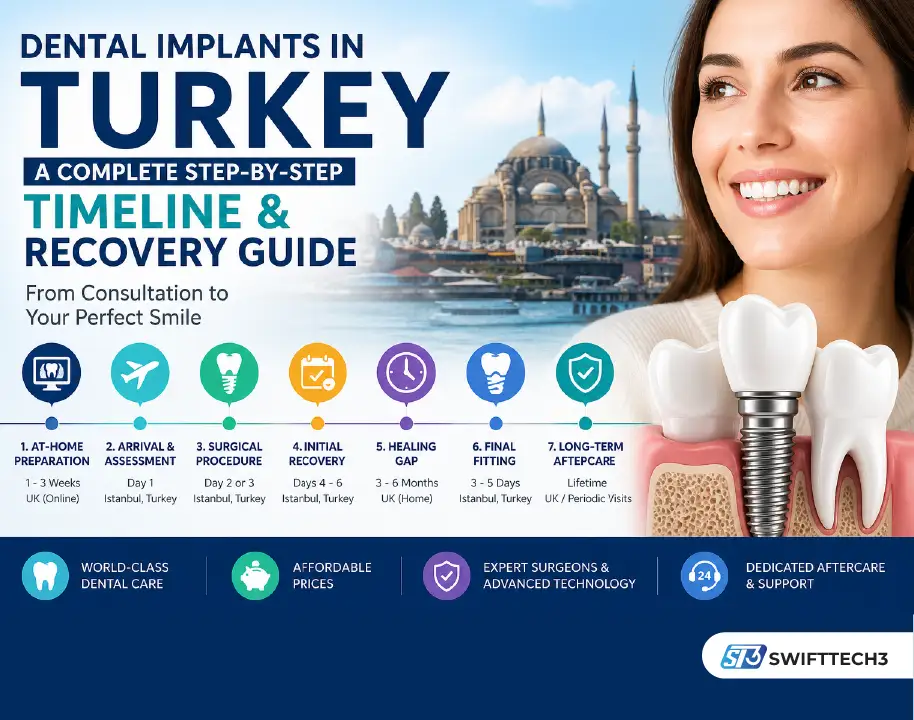
From Consultation to Recovery: A Step-by-Step Timeline of Getting Dental Implants Abroad
The decision to travel for medical care is rarely made overnight. It usually begins at a kitchen table in London, Manchester, or Glasgow, staring at a private dental quote that costs more than a family car. You’ve likely heard the success stories of Dental Implants in Türkiye, but the “how” can feel daunting. How do you go from a broken tooth in the UK to a finished set of implants in Istanbul?
At Dentakay Dental Clinics, we believe transparency is the foundation of trust. Getting dental treatment in Turkey shouldn’t feel like a leap of faith — it should feel like a well-coordinated process, with the real trade-offs laid out alongside the benefits. Below is a step-by-step timeline of what to expect, along with what’s genuinely worth weighing before you book a flight.
Phase 1: The “At-Home” Preparation (Weeks 1–3)
Your journey doesn’t start at the airport; it starts in your living room. NHS dentistry access remains genuinely uneven — official NHS statistics show real regional disparities in England, with areas of lower dentist availability seeing notably higher rates of A&E visits for dental problems (roughly 1 in 460 people in the South West versus 1 in 860 in London, according to analysis referenced by the British Dental Journal, 2025). That access gap, not a single dramatic national spike, is what actually drives most patients toward exploring options abroad.
The Virtual Consultation
You reach out via website or WhatsApp, provide a recent panoramic X-ray (if available) or clear photos of your teeth and gums, and specialists review your case to provide a preliminary treatment plan and quote before you travel.
A genuine consideration here: sending X-rays or medical photos to a clinic outside the UK is a cross-border health data transfer, and Turkey does not currently hold a UK adequacy decision under UK GDPR — meaning the data isn’t automatically presumed to receive equivalent protection. Reputable clinics handle this through appropriate contractual safeguards or explicit informed consent, but it’s worth asking directly how your scans and records are transferred and stored before sending anything.
Booking and Logistics
Patient coordinators help arrange dates, hotel recommendations, and transfer details once you’re happy with the plan.
Phase 2: The Istanbul Arrival & Clinical Assessment (Day 1)
When you land in Istanbul, the travel portion ends and the clinical portion begins. Even with UK X-rays already reviewed, most clinics perform their own 3D Cone Beam CT (CBCT) scans on arrival — genuinely more informative than a standard 2D panoramic X-ray, since CBCT builds a three-dimensional model of the jawbone showing bone density and nerve position with enough precision to plan implant placement to the millimeter. You’ll then meet your surgeon to finalize the plan based on that imaging.
Phase 3: The Surgical Procedure (Day 2 or 3)
A single implant typically takes 20–30 minutes; more complex “All-on-4” cases can run 2–3 hours, with sedation options ranging from local anesthesia to conscious sedation. In many cases, a temporary bridge or crown can be attached the same day or the next (“immediate loading” / “teeth in a day”), though whether this is appropriate depends on individual bone quality and case complexity — it isn’t universally available or advisable for every patient.
Phase 4: Initial Recovery (Days 4–6)
A follow-up check typically happens the day after surgery to confirm healing is on track. Patients are usually given a soft-food guide for the first several days and can generally move around the city at a gentle pace, though how much “holiday” activity is appropriate varies by individual recovery.
Phase 5: The “Healing Gap” (Months 3–6)
Osseointegration
Titanium or zirconia implants need time to fuse with the jawbone — a process called osseointegration that typically takes 3 to 6 months, during which the bone grows around the implant.
Remote Monitoring
This is genuinely the phase where the process most depends on the clinic’s follow-up infrastructure, since you’re back in the UK without in-person access to the surgical team. Patients typically send photos or updates and can arrange video consultations if issues arise. This is also the phase with the most real risk in dental tourism generally: if a complication develops mid-healing — infection, implant failure, or a fit issue — managing it from a different country, potentially requiring a UK dentist unfamiliar with the original surgical plan to intervene, is a genuine practical challenge worth planning for before you commit, not after something goes wrong.
Phase 6: The Final Fitting (Trip #2: 3–5 Days)
High-precision digital impressions replace the older physical mold-taking process, feeding directly into the design of permanent crowns or bridges. Clinics with in-house labs can control color, translucency, and shape more closely than those outsourcing lab work, which is worth asking about directly when comparing providers.
Phase 7: Long-Term Success and Aftercare
Implants require the same ongoing care as natural teeth — brushing, flossing, and regular check-ups — ideally continuing with a UK dentist who has access to your treatment records for future monitoring.
| Timeline Stage | Duration | Location |
|---|---|---|
| Stage 1: Consultation | 1–2 Weeks | UK (Online) |
| Stage 2: Surgery Trip | 5–7 Days | Istanbul, Turkey |
| Stage 3: Bone Healing | 3–6 Months | UK (Home) |
| Stage 4: Final Fitting | 3–5 Days | Istanbul, Turkey |
| Stage 5: Aftercare | Lifetime | UK / Periodic Visits |
Weighing the UK vs. Turkey Path
UK NHS dental waiting times and dentist availability vary significantly by region, and private UK implant pricing (often £2,500+ per implant) can include fewer bundled follow-up visits than some overseas packages advertise. That said, cost comparisons should account for flights, accommodation across two trips, and the practical cost and difficulty of managing any complication remotely — a genuinely balanced comparison, not just a headline price difference.
What “Teeth in a Day” and CBCT Actually Represent
The clinical technology behind modern implant dentistry — CBCT imaging, digital impression scanning, and AI-assisted treatment planning software increasingly used to simulate implant placement before surgery — has measurably improved planning precision industry-wide, not just at any single clinic. This broader shift toward AI-assisted diagnostic imaging is changing several fields of medicine at once, dentistry included, and is worth understanding as a genuine advance independent of where you choose to be treated.
Questions Worth Asking Before Booking Anywhere
- How is my medical imaging data transferred, stored, and protected?
- What happens if I develop a complication after returning to the UK — who manages it, and at what cost?
- Is the clinic independently accredited, and can I verify surgeon credentials directly?
- What’s actually included in the quoted price versus billed separately?
- Does the clinic have a lab in-house, or is that work outsourced?
FAQ
Is it safe to fly after dental implant surgery?
Most patients can safely fly within 24–48 hours post-procedure, provided there are no complications and the treating dentist approves.
How long does the full dental implant process take?
The complete timeline typically runs 3 to 6 months, including bone healing and final crown placement.
What happens if something goes wrong after I’m back in the UK?
This is the most important practical question to resolve before treatment — ask specifically how the clinic supports remote complication management and whether a local UK dentist can access your treatment records if needed.
Is my medical data protected when sent to a clinic abroad?
Turkey doesn’t currently hold a UK GDPR adequacy decision, so data transfers rely on contractual safeguards or explicit consent rather than automatic equivalence — ask the clinic directly how your records are handled.
Will I be without teeth during treatment?
Not necessarily — “teeth in a day” temporary restorations are common, though suitability depends on individual bone quality, not guaranteed for every case.
Next Steps
Gather any recent dental records or X-rays, ask direct questions about data handling and complication support alongside the standard consultation questions, and compare the full cost — flights, accommodation, and worst-case complication scenarios — not just the headline implant price.