A hacker described the backend of an AI companion platform as “a handful of open-source projects duct-taped together.” That single sentence explains most of what went wrong when Muah.ai was breached in 2024 — and why the incident became one of the most consequential AI security stories of the past two years, studied by law firms, regulators, and security researchers well outside the AI companion niche.
What Actually Happened
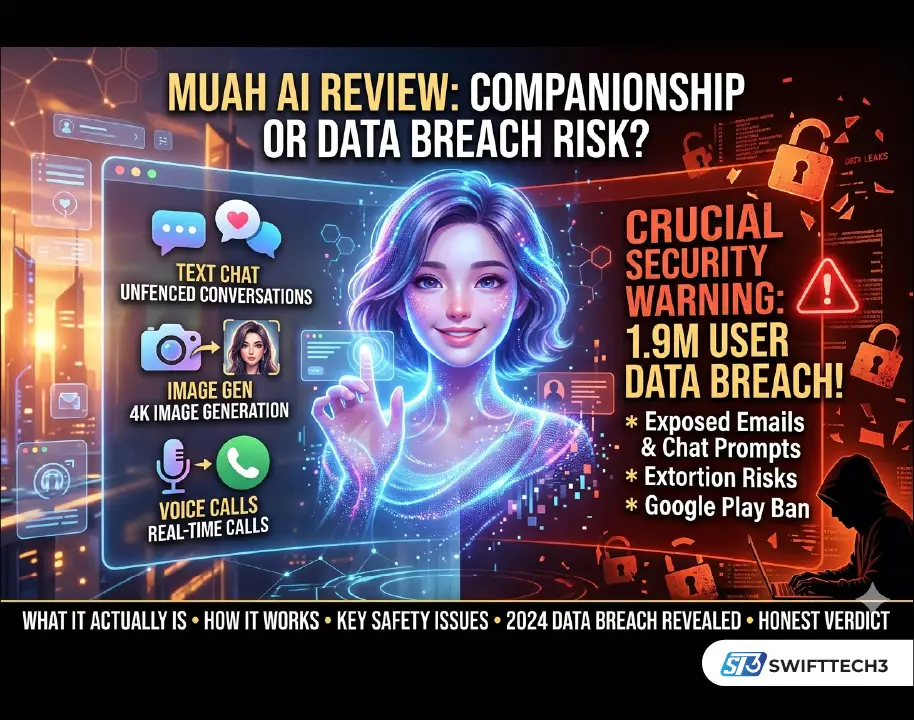
On September 17, 2024, an attacker exploited weak security controls on Muah.ai, an AI companion platform, and extracted a database covering roughly 1.9 million user accounts. The breach became public on October 8, 2024, when 404 Media published its findings and the incident was added to Have I Been Pwned with a “sensitive breach” designation — a category reserved for data whose exposure carries outsized personal risk. The stolen data included email addresses, many tied to real names, alongside the actual chat and image-generation prompts users had typed into the platform.
Why This Wasn’t a “Normal” Breach
Most breaches expose static data — passwords, card numbers, addresses. This one exposed something harder to walk back: the specific, personal content people had typed into a chatbot believing it was private. Security researchers who reviewed the leaked data reported that a significant share of the prompts described sexual content involving minors — a finding serious enough that outlets covering the story, including 404 Media and Malwarebytes, flagged potential legal exposure for the users involved, not just the company. Law firm Linklaters, analyzing the breach, drew a direct comparison to the 2015 Ashley Madison hack, where exposed user data led to sustained blackmail campaigns. Because the Muah.ai data linked real email addresses directly to sensitive prompts, security analysts warned of the same extortion pattern — and reports have since described attackers using the data to pressure exposed individuals, including attempts to leverage IT employees into compromising their employers’ systems.
The Root Cause: A Platform Built Faster Than It Was Secured
The technical story behind the breach is almost more instructive than the breach itself. The attacker told 404 Media the platform was “a handful of open-source projects duct-taped together,” and that the vulnerabilities were easy to find. That’s a pattern security teams see constantly in fast-growing consumer apps: rapid feature shipping — in this case, image generation, voice cloning, and real-time voice calls — outpacing basic security hygiene like access controls, encryption at rest, and input sanitization. Speed to market and security maturity are not the same investment, and this breach is a clear example of what happens when a company optimizes almost entirely for the former.
Personal Experience: What This Looks Like From a Security Review Seat
Reviewing incidents like this for a living, the giveaway is rarely the exploit technique — it’s the response afterward. A mature security posture produces a public incident timeline, a specific list of what was exposed, and a concrete remediation plan with dates attached. Muah.ai’s public response was a brief acknowledgment and a claim that a rival had sponsored the attack, offered without evidence. That’s the bigger red flag than the breach itself: an unverifiable deflection instead of a transparent post-mortem tells you the company hadn’t built the incident-response muscle before it needed it — and that gap tends to predict how the next incident gets handled, too.
How This Breach Compares in Scale
| Breach | Year | Records Exposed | Most Sensitive Data Type |
|---|---|---|---|
| Muah.ai | 2024 | ~1.9 million | Personal chat/image prompts tied to real identities |
| Ashley Madison | 2015 | ~32 million | Account and payment data tied to real identities |
| 23andMe | 2023 | ~6.9 million | Genetic ancestry and relative-matching data |
Muah.ai’s exposure is smaller by volume than either comparison, but the sensitivity-per-record is arguably higher — genetic data and infidelity records are damaging, but prompts directly documenting a user’s private, often illegal-adjacent intent are a different category of exposure entirely.
What This Means for Anyone Building or Using AI Chat Platforms
This incident is a live example of why regulators are starting to treat AI companion apps as a distinct risk category rather than ordinary consumer software. Australia’s eSafety Commissioner has since reviewed Muah.ai as part of its online safety guidance, specifically flagging data collection practices and the adequacy of content moderation — a signal that AI platforms handling emotionally intimate or explicit user input face a higher regulatory bar than a typical SaaS product. For anyone evaluating a SaaS product’s security posture, this case is a useful worst-case reference: strong encryption claims mean little if input moderation and access controls are an afterthought.
How to Protect Yourself on Any AI Chat Platform
- Use a dedicated email address for any app that stores personal or sensitive conversation data — never a primary or work account.
- Never include identifying details — full name, employer, location — in a chat you wouldn’t want traced back to you.
- Periodically check your email against Have I Been Pwned to catch exposures early.
- Read a platform’s data retention policy specifically — how long conversations are stored and whether they’re used for model training. For a broader look at what’s at stake, this breakdown of growing online privacy risks covers the wider pattern behind incidents like this one.
FAQ
When did the Muah.ai breach happen?
The breach occurred September 17, 2024, and became public on October 8, 2024, when 404 Media published its findings and the incident was added to Have I Been Pwned.
How many people were affected?
Approximately 1.9 million email addresses were exposed, along with the chat and image-generation prompts tied to those accounts.
Why was this breach considered unusually serious?
Because the exposed data linked real identities directly to private, sensitive prompt content — creating both reputational and legal exposure, and a documented extortion risk, rather than just the usual password-reset inconvenience.
What caused the breach?
According to the attacker’s own account to 404 Media, the platform’s backend combined multiple open-source components without adequate security hardening, making the vulnerabilities easy to find and exploit.
Did regulators respond to the incident?
Australia’s eSafety Commissioner has since reviewed the platform as part of its online safety guidance, specifically citing data collection and content moderation concerns.
What should someone do if their data was part of a breach like this?
Check Have I Been Pwned to confirm exposure, be alert to unsolicited contact referencing account or personal details, and treat any such contact as a potential extortion attempt rather than a legitimate request.
Actionable Takeaway
If you’re evaluating any app that stores sensitive personal input — health data, financial details, or private conversations — check for a public incident-response history and specific security claims (encryption standards, access control practices) before checking the feature list. Speed of feature releases is not a security signal, and this breach is the clearest recent example of why that distinction matters.