“He’s got it in for me.” “I deserved that promotion more than they did.” Frustration like this often has less to do with your actual work and more to do with signals you’re sending without realizing it. Bosses and colleagues will readily tell you when a deliverable is late. Almost nobody will tell you that you crossed your arms through the whole meeting. Body language is the feedback gap most workplaces never close — though that’s starting to change, partly because software now catches what colleagues won’t say out loud.
What Body Language Actually Communicates
Your body language is everything you say without opening your mouth — posture, eye contact, gestures, the angle of your body toward or away from someone. You’re sending these signals constantly, mostly without noticing. You’ve probably rehearsed what to say in a difficult meeting with your manager. Far fewer people rehearse how they’ll sit, where they’ll look, or what their hands will do — and that gap is often what actually gets remembered.
Personal Experience: Where I Actually Noticed the Gap
I once sat through a performance review where I was told my “presence in meetings needed work” — no further detail. It took recording myself in a mock video call, then watching it back, to see the problem: I nodded so rapidly while others spoke that it read as impatience rather than engagement, and I almost never turned my torso toward whoever was talking. No manager was ever going to say “your torso angle is off.” Recording and reviewing myself is what actually surfaced it — which is exactly the gap that AI coaching tools now try to close automatically, in real time, instead of waiting for an annual review to hint at it vaguely.
Six Habits Worth Fixing
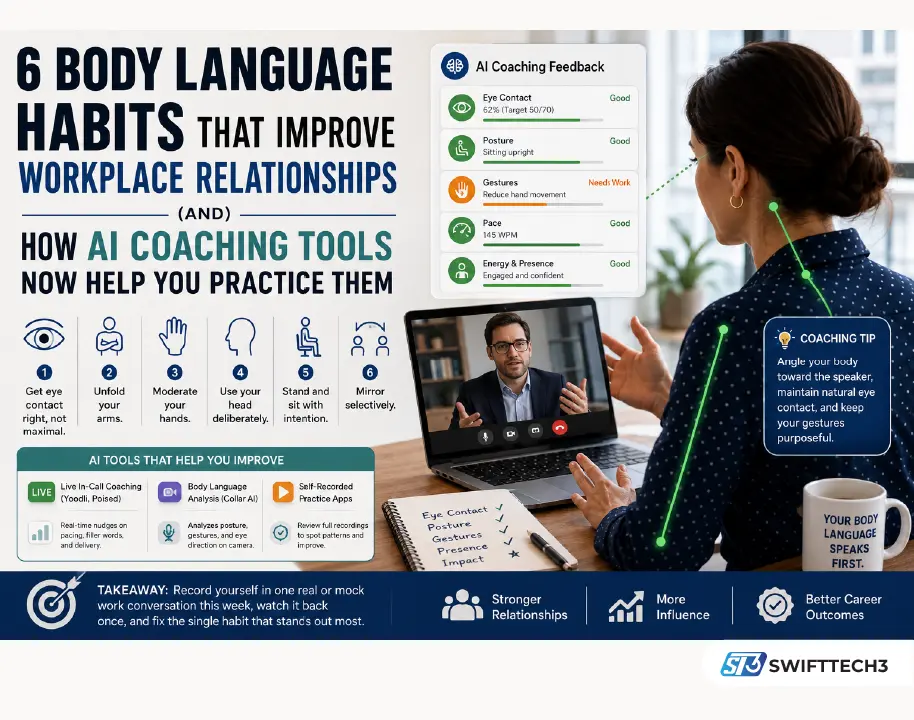
1. Get eye contact right, not maximal. The 50/70 rule is a useful anchor: aim for eye contact roughly 50% of the time while speaking and 70% while listening. Staring is as damaging as avoidance. Interestingly, Stanford’s Virtual Human Interaction Lab found that video calls create an unnatural excess of eye contact — everyone stares at everyone, all the time, which is part of why back-to-back video meetings feel so draining. Knowing this helps explain why “good eye contact” on a video call sometimes means deliberately looking away more than instinct suggests.
2. Unfold your arms. Crossed arms often read as defensive or closed off, even when it’s really just a comfort habit. Keep arms relaxed at your sides except when gesturing.
3. Moderate your hands. Expressive hands support your point; constant motion distracts from it. Find a middle ground between animated and chaotic.
4. Use your head deliberately. A slight tilt while listening signals attentiveness. Occasional nodding shows engagement — overdo it and it reads as performative rather than genuine.
5. Stand and sit with intention. Shoulders back, head level, feet roughly shoulder-width apart, knees relaxed. Angling your body slightly toward the person you’re speaking with projects warmth without invading space.
6. Mirror selectively. Subtly matching another person’s posture or gestures builds rapport at a subconscious level — a well-documented effect in social psychology. It only works when it’s subtle; obvious mimicry reads as mockery.
How AI Coaching Tools Are Changing How People Practice This
A decade ago, the only ways to get real feedback on this were a human coach, a video camera, or a colleague blunt enough to mention it. Now there’s a third option: AI communication-coaching software that runs quietly during video calls or practice sessions and flags issues as they happen. Tools like Yoodli give private, real-time nudges on pacing, filler words, and delivery during actual meetings, while newer entrants like Collar AI specifically target on-call body language through video analysis during platforms like Google Meet.
| Tool Type | What It Analyzes | Best For |
|---|---|---|
| Live in-call coaching (e.g., Yoodli, Poised) | Pacing, filler words, speaking time; some track visual delivery | Regular video meetings, sales calls |
| Body-language-specific video analysis (e.g., Collar AI) | Posture, gesture, eye direction on camera | Practicing before high-stakes calls |
| Self-recorded practice apps | Full playback review, similar to recording yourself manually | Interview prep, presentation rehearsal |
None of these replace a trusted colleague’s honest opinion. What they add is consistency — feedback every single call, not just the one time someone happens to mention it. If you’d rather work through this in a structured way with a human-designed curriculum instead of app-based nudges, a body language course from ZandaX covers the underlying theory alongside practical drills, which pairs well with using an AI tool for ongoing, day-to-day feedback.
The Trade-Off: Video Calls Distort Body Language Anyway
It’s worth acknowledging that body language reads differently on camera than in person. Camera framing, lag, and the sheer amount of forced eye contact on video calls all change how gestures and posture land — which is part of why Stanford’s Bailenson found nonverbal overload to be a genuine driver of video-call fatigue, not just an anecdotal complaint. If you’re coaching yourself on body language primarily through video call recordings, calibrate for that distortion rather than assuming in-person habits translate one-to-one.
FAQ
What’s the fastest body language fix to make? Uncrossing your arms and adjusting eye contact toward the 50/70 rule — both are immediate and don’t require practice.
Do AI coaching apps actually work? They’re useful for consistency and catching patterns you can’t see yourself, though they work best alongside, not instead of, human feedback.
Why does eye contact feel exhausting on video calls specifically? Stanford research attributes this to unnaturally close, constant eye contact that doesn’t occur in in-person meetings.
Is mirroring manipulative? Not when it’s subtle and genuine — it’s a natural rapport-building behavior, not a trick, as long as it isn’t exaggerated.
How do I know if my body language is a problem? Record yourself in a mock conversation or presentation and watch it back — most people are surprised by what they see.
Can body language really affect promotions? Indirectly, yes — it shapes perception of confidence and engagement, which factors into how colleagues and managers evaluate you even when they can’t articulate why.
Takeaway
Record yourself in one real or mock work conversation this week, watch it back once, and fix the single habit that stands out most — don’t try to overhaul everything at once.