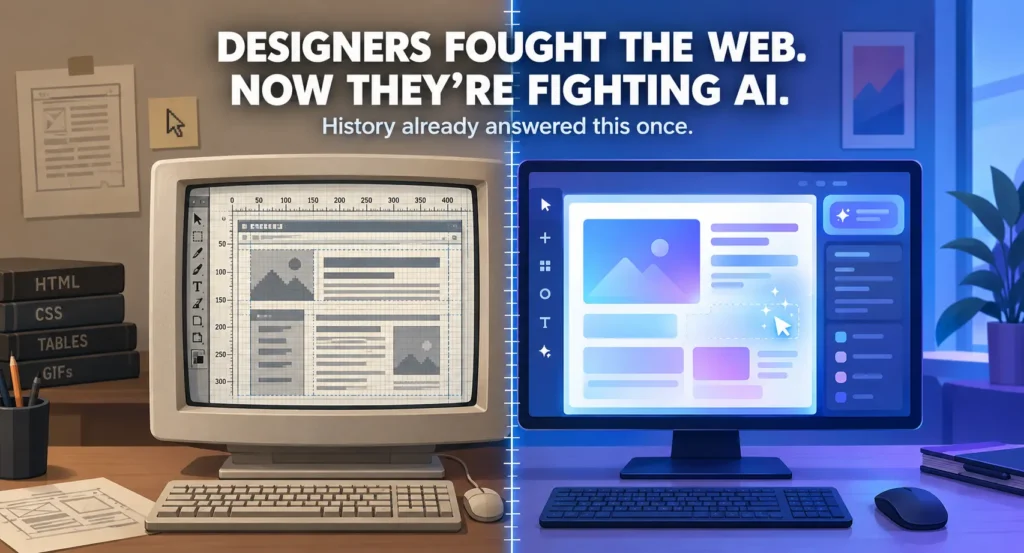
Designers have run this exact argument before, and the historical record says something specific about who was right and why.
Where “Pixel-Perfect” Actually Came From
In April 2000, John Allsopp published “A Dao of Web Design” in A List Apart, arguing against print designers who’d moved to the web and were trying to force browser pages to behave like paper — fixed widths, frozen type, a layout that had to look identical on every machine or be considered broken. Print gave every dot of ink a fixed position once a job went to press, and designers who’d trained on that expectation treated reproducing a mockup pixel-for-pixel as the actual job. For a few years, uniform 800×600 monitors made that illusion mostly hold. Then screens multiplied, and no amount of skill could put the fixed canvas back.
Allsopp’s essay was mostly rejected by the audience it targeted — people comfortable in Photoshop and QuarkXPress weren’t eager to hear that their core skill was aimed at the wrong target.
The Argument Was Never About Whether the Web Was Good
Allsopp’s real point was about where control actually comes from. Print precision was a side effect of paper’s fixity, not a design achievement, and demanding that same frozen layout from a medium built to reflow meant fighting the medium instead of using it. Ten years later, Ethan Marcotte published “Responsive Web Design” in the same publication and opened by quoting Allsopp directly — the essay that had been dismissed became the foundation of how the web is actually built today.
Some teams moved early anyway. In late 2001, a Razorfish team rebuilt Audi.com with a layout that adapted to browser width, with Jürgen Spangl and Jim Kalbach on information architecture and Ken Olling on design; Kalbach later called fixed-size pages a fundamentally flawed practice that wasted the medium. Nine years passed before the industry treated that as normal. Fixed 960-pixel layouts kept shipping the whole time, breaking every time someone dragged a window narrower. Control over the medium came back only when Steve Jobs’s April 2010 “Thoughts on Flash” pushed the industry away from a plugin promising pixel-identical control everywhere, toward standards that handed control back to the browser.
The Same Nerve, Now About Execution
“AI will take our jobs” is what designers say out loud. Underneath sits a quieter worry: that the work stops being something made by hand. A CHI 2025 paper — “Catalyst for Creativity or a Hollow Trend?” by Syeda Masooma Naqvi, Ruichen He, and Harmanpreet Kaur — interviewed 28 designers who learned the craft before and after Midjourney and DALL-E, and found the most senior designers were the most wary of losing foundational skill to the prompt. Their unease sat with the craft itself, not the paycheck.
The adoption numbers moved anyway. Figma’s State of the Designer 2026 report, surveying 906 designers, found 72% now use generative AI tools and 98% increased usage over the past year; 91% say the tools improve their designs. A separate UserTesting study, Defensible Design in the Age of AI, found 91% of designers say the work moves faster with AI, but only 15% feel much more confident in the resulting quality — and in Figma’s prior 2025 report, trust in AI output scored just 32%, the lowest of any measure the survey tracked. The tools spread through the workflow years ahead of any trust in what they produce. That 2025 report also found a split by role: 54% of designers said AI improved the quality of their work, against roughly 68% of developers — a gap that makes sense once you notice a developer can run a test and watch AI-written code pass or fail, while a designer evaluating a layout has no equivalent test to run. The studios handling this well have mostly stopped moving every element by hand and started directing the result through instruction instead — some of the top web design agencies are working that way already, rather than resisting it.
Personal Experience: Watching the Same Fight Twice
Having sat through both transitions from a design-leadership seat, the pattern repeats almost exactly. The first time, the anxious question was “how do I keep this looking the same everywhere,” and the answer that actually worked was to stop asking it — to define rules for how a layout should behave under conditions nobody could fully predict, rather than trying to lock down every pixel. The AI version of that same anxious question is “how do I keep control of the first draft,” and the teams handling it well have made the identical move: they stopped treating every element as something they personally place, and started treating the brief itself — the instructions, the constraints, the judgment about what’s actually worth shipping — as the real craft. The tool changed. The underlying skill that mattered didn’t.
Two Disruptions, Compared
| Responsive Web Design | Generative AI in Design | |
|---|---|---|
| What designers lost control over | The fixed canvas | The first-draft execution |
| Who still made every decision | The designer, every time | Increasingly, the model — until reviewed |
| Adoption lag after the key essay/tool | ~9 years (Kalbach 2002 → industry norm ~2010) | Under 2 years (72% adoption by 2026) |
| Trust in the new approach | High once adopted | Still low (32%) even amid high adoption |
| Job market impact | Roles shifted, didn’t shrink | Google Cloud cut 100+ design/UX roles in Oct. 2025 |
Where the Comparison Breaks
Responsive design still ran entirely on human decisions — the canvas went fluid, but a designer still chose every element that landed on the screen. AI reaches further, generating a finished layout or a first-draft interface before anyone has touched it. Losing a fixed width changed the material designers worked in; this changes who does the first pass, and that’s where the comparison stops being clean. In October 2025, Google cut more than 100 design and UX research roles from its Cloud division, halving some teams and shifting the budget toward AI — the fear about disappearing work has payroll behind it this time, and waving it off with “the web scare turned out fine” would be its own kind of condescension.
What to Do With the Old Pattern
The useful move for a design lead right now is the one that separated the designers who thrived after 2000 from the ones who didn’t: stop defending control over the old carrier, and find what’s genuinely impossible to compress in the new one. When the fixed canvas dissolved, the scarce skill turned out to be judgment about how a design should behave under conditions you couldn’t see in advance. Now that execution itself is cheap, the scarce skill is deciding what’s worth making at all — and knowing when a fast result is simply wrong. That’s exactly the confidence the 15% figure above says most designers don’t have yet.
FAQ
What was “A Dao of Web Design” actually arguing?
That the web’s flexibility — different screens, different browsers, no fixed canvas — was a feature to be embraced, not a defect to engineer around, and that fighting it to reproduce print-style fixed layouts wasted the medium’s actual strength.
How long did it take the industry to accept responsive design?
Roughly a decade — Jim Kalbach called fixed-width pages flawed in a 2002 write-up on the Audi.com redesign, but responsive design only became standard practice after Ethan Marcotte’s 2010 essay and Steve Jobs’s 2010 letter killing Flash on mobile.
What percentage of designers use generative AI tools today?
72%, according to Figma’s State of the Designer 2026 report, with 98% of those users increasing usage over the prior year.
Do designers actually trust AI-generated output?
Not especially — Figma’s 2025 AI report put trust in AI output at just 32%, the lowest score of any metric the survey measured, even as adoption climbed.
Has AI actually cost design jobs, or is it just a fear?
It’s had real payroll impact in at least one documented case — Google cut more than 100 design and UX research roles from its Cloud division in October 2025, explicitly reallocating budget toward AI.
Is the AI disruption in design really comparable to the shift to responsive web design?
Partially. Both challenged a designer’s sense of control over the finished product, but responsive design left every decision with the human designer, while generative AI can produce a full first draft before a person is involved — a deeper shift in who does the initial work.
Actionable Takeaway
If you lead a design team right now, don’t spend your energy defending the old point of control — the hand-placed pixel then, the untouched first draft now. Spend it building the judgment layer that decides what’s worth shipping and what a fast AI result got wrong, because that’s the skill history says survives the transition, and it’s also the exact skill the 15%-confidence figure above says the industry hasn’t built yet.
Visit: Swifttech3